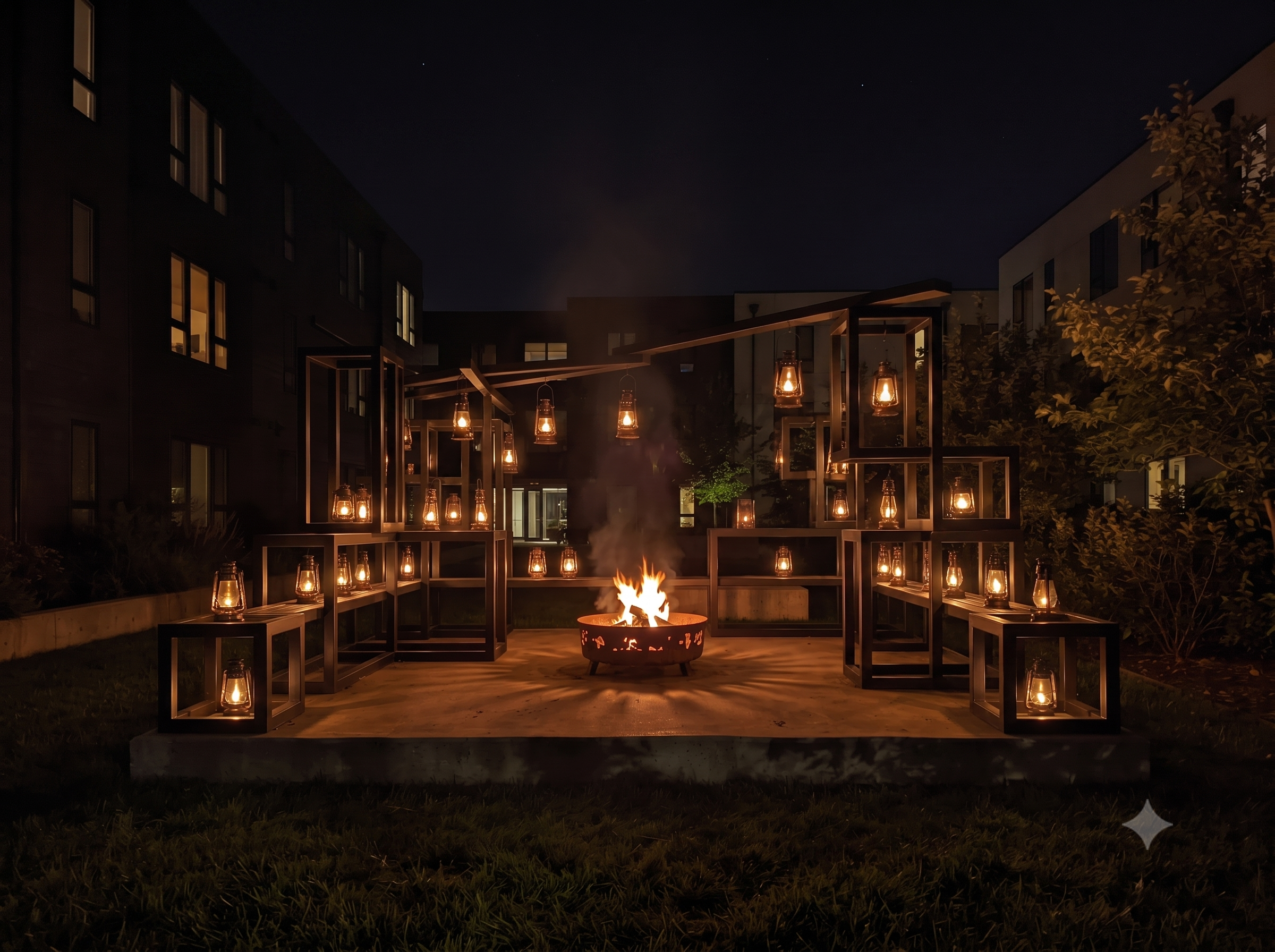
You build a courtyard in your backyard—stone or brick, open to the sky, enclosed enough to hold stillness. Twenty lanterns are dispersed throughout the space, each mounted on a post or hanging from a branch, each waiting to be claimed by a moment of your life. In the center burns a fire pit, the heart of the ritual, the place where you will return again and again to confront what you are and what you want to become.
The practice begins on your thirtieth birthday and continues for twenty years. Each year, you choose one moment from your life when you felt most in harmony with your ideal vision of yourself—not when you were perfect, but when you were aligned. The moment you stood up for someone who couldn’t defend themselves. The conversation where you told the truth even though it cost you something. The moment you mastered a piece of music before a large audience. Each moment gets a lantern. You spend time with it—writing about why it mattered, what it revealed about the person you want to be, how it felt to live inside your aspirational self even briefly. The lantern becomes a marker, a beacon, a reminder that you have been that person before and can be again.
But the courtyard is not just about celebration. At least three times a year, you perform the ritual of release. You sit by the unlit fire pit and write down everything that pulls you away from your aspirational self—the recent disappointments, the regrets, the bad habits you can’t seem to break, the moments when you failed to be who you wanted to be. You write it all down on paper, holding nothing back. Then you light the fire. You watch the list burn, the smoke rising, the words turning to ash. This is not about shame. This is about acknowledgment and letting go.
Once the fire is burning strong, you use its flame to light the lanterns you have claimed so far in your lifetime. One by one, they illuminate. If you’re in your thirty-fifth year, five lanterns glow across the courtyard. By your fortieth, ten. By your fiftieth, all twenty burn together, a constellation of your best self scattered across the space. You sit in the center, surrounded by firelight and memory, holding the tension between who you are and who you are becoming. The disappointments have burned away. The aspirational moments remain, glowing in the dark.
Over twenty years, the courtyard transforms. What begins as mostly darkness—a few lanterns lit, vast stretches of shadow—becomes a field of light. Each lantern holds a story of alignment, a moment when you touched the person you were meant to be. The fire pit holds every failure, every regret, every stumble along the way. Together, they create a visual archive of self-making: the light you’re building toward, the darkness you’re releasing, the practice of choosing who you become.
By the time all twenty lanterns are lit, you are fifty years old. You have spent two decades defining your aspirational self through lived moments, not abstract ideals. You have burned dozens of lists. You have sat in that courtyard through every season, every mood, every version of yourself. And now, when you light the fire and all twenty lanterns blaze together, you sit in a space that says: This is who I have been at my best. This is the self I am still building. This is the light I choose to carry forward.
Alternatives Meanings for the Court Lanterns
The Hardest Things Ever Done – Moments when you did something that scared you, moments that required real courage, changed you through struggle.
Losses That Became Wisdom – Each lantern memorializes a specific loss—a relationship, a dream, an identity—and the wisdom that emerged from grieving it. You’re honoring what the grief taught you.
Life Crossroads – Each lantern represents a meaningful choice or life intersection that shaped your life in a profound way. Each lantern symbolizes that commitment made and the parallel lives that might have emerged if a different direction was taken.
A Fear You Conquered – The lanterns represent fears you overcame each year and the experiences that demonstrated it. The court becomes a three-dimensional auto-biography of your courage in face of difficulty.
Reciprocated Love – Specific moments when love was mutual, when you felt as loved as you loved. Not love in general, but the rare symmetry of it.

