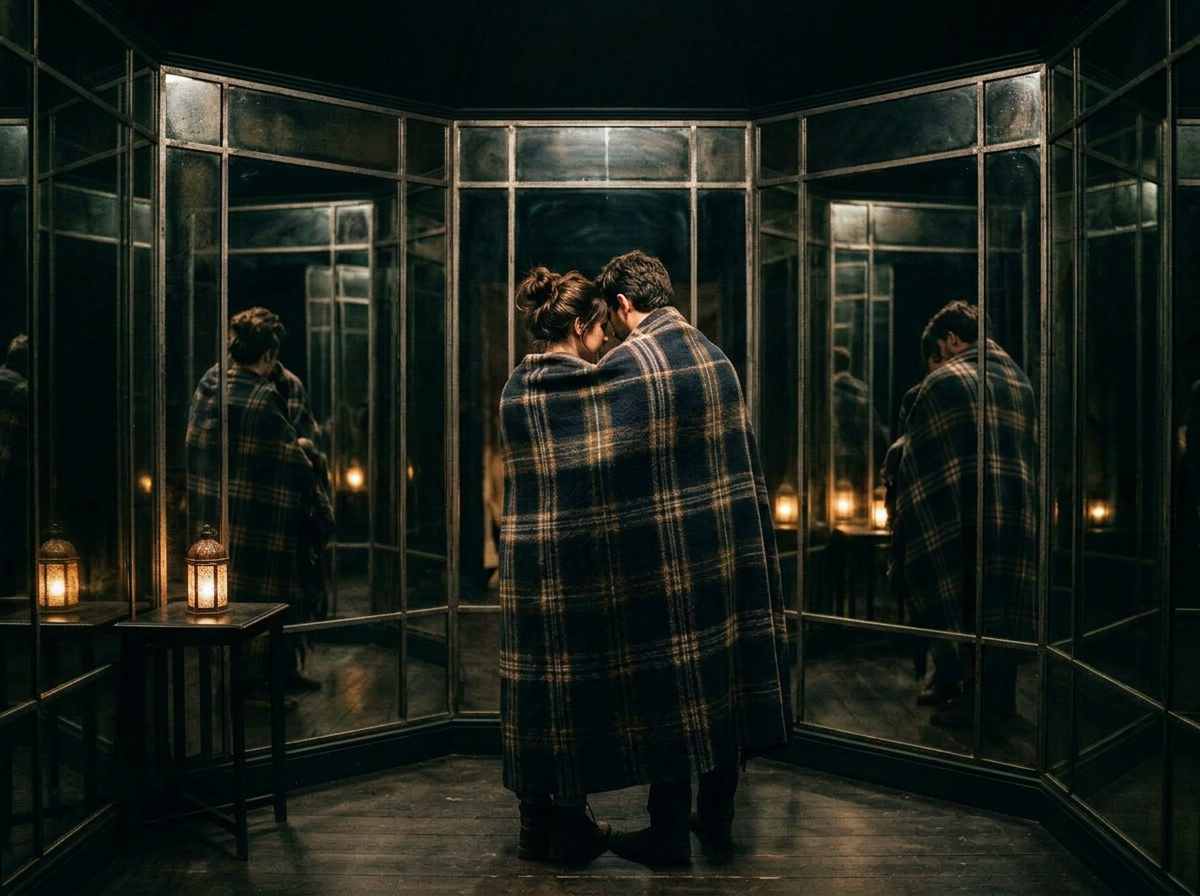
Being truly seen is rarer than being loved. Most people spend their lives performing for audiences who aren’t really watching, speaking truths to rooms that aren’t really listening. This experiment creates the conditions for radical recognition—a space where strangers witness your unfiltered self and choose you not despite your truth, but because of it.
Enter an octagonal chamber with seven mirrored walls. You cannot see through them, but behind each mirror, a stranger sits in darkness, watching you. Around each mirror’s frame, a colored LED light—amber, violet, emerald, crimson, sapphire, gold, silver—waits dormant. You sit in the center on a simple chair. The room is warm, almost uncomfortably so. A soft voice through hidden speakers begins asking questions, and you answer into the silence, not knowing who’s listening or if anyone cares.
The questions start gently: What do you believe about love? What frightens you most about your future? Describe a moment when you felt completely alive and happy. But they deepen quickly: What have you done that you most regret? What do you want that you’re ashamed to admit? If you could tell your younger self one truth, what would most upset them?
You speak your answers aloud. Sometimes your voice cracks or trails. Sometimes you laugh at your own responses. Sometimes you say things you’ve never said to anyone, not even yourself in the mirror at 3 AM. And as you speak, the lights begin to respond.
A violet glow when you describe your fear of disapointment. Amber flickers when you admit you’re terrified of being forgotten. Emerald blazes when you confess the thing you’ve never told anyone. The observers behind the mirrors press their buttons when something you say moves them or resonates with them deeply—not agreement, but understanding. They’re not judging your performance. They’re witnessing you for who you are.
As the session continues, you start noticing patterns. Certain mirrors light up consistently. Others stay dark. You begin speaking toward the lights that see you, unconsciously orienting your body, your voice, your vulnerability toward the witnesses who are actually paying attention. The questions grow more intimate: What would you do if you knew you were immune to failure? What do you need that you’ve never asked for? Who do you become when no one’s watching?
Eventually, you select and narrow your focus to three mirrors—the ones that lit up when you were most honest, most raw, most yourself. The four eliminated mirrors go dark. And then you notice: the temperature drops. Not dramatically, but enough that you feel it on your skin, your breath visible in the air. The room that held you in warmth now asks something of you. The cold becomes urgency. You’re getting closer to something real, and your body knows it.
Then the voice announces: “Now you may ask the witnesses anything. You have three questions.”
The power shifts. You’re no longer the only one exposed. You think for a moment, then speak your first question into the chamber: “What is a belief that you hold but have never told anyone?” or “What do you wish someone would understand about you that they never ask?” or “What made you light up most when I spoke?” The three remaining observers answer through hidden speakers, their voices filling the space for the first time. You hear strangers respond to your curiosity with their own vulnerability. The dynamic changes. You’re in conversation now, not performance.
After your three questions, the voice returns inviting you to listen to a confession from each remaining witness. Something they have never told anyone. The voice says, “Listen, then make your selection.” Through headphones, you hear three strangers offer you their own unguarded truths. A confession they recorded in private before the event. A revealing moment that conveys more about them than you have yet learned. You listen to each confession in the cold, your body shivering slightly, and you realize: recognition isn’t one-directional. These strangers saw you, and now you’re seeing them back.
You choose one. You say their color aloud—”Violet” or “Emerald” or “Gold.”
A door opens in that mirror. The stranger steps through carrying a thick blanket. They walk to you, wrap it around your shoulders, and as they do, warmth floods back into the chamber. The cold releases. You feel your body relax into the heat, into the presence of another person who chose to see you and be seen in return.
You don’t sit in silence. You speak. Quietly, intimately, without the questions or the lights or the performance. You ask each other the things you actually want to know. You laugh. You admit things you didn’t say during the session. You discover that the person who saw you is also someone you want to keep seeing. The barriers dissolve—not because you’ve performed perfectly, but because you’ve both been willing to be witnessed in your imperfection.
By the end, you understand: being truly seen isn’t about finding someone who loves every part of you. It’s about finding someone brave enough to watch you tell the truth and say, “Yes, I see that. I see you. And I’m still here.” Recognition becomes mutual. The cold becomes warmth. And what started as an experiment in being chosen becomes an experiment in choosing back—in discovering that intimacy begins the moment two people stop performing and start speaking like they mean it.

