Grief is not meant to be private. It’s too large, too sacred, too human to be contained in one body. When someone you love dies, the world loses them too—and the world deserves to witness what they meant.
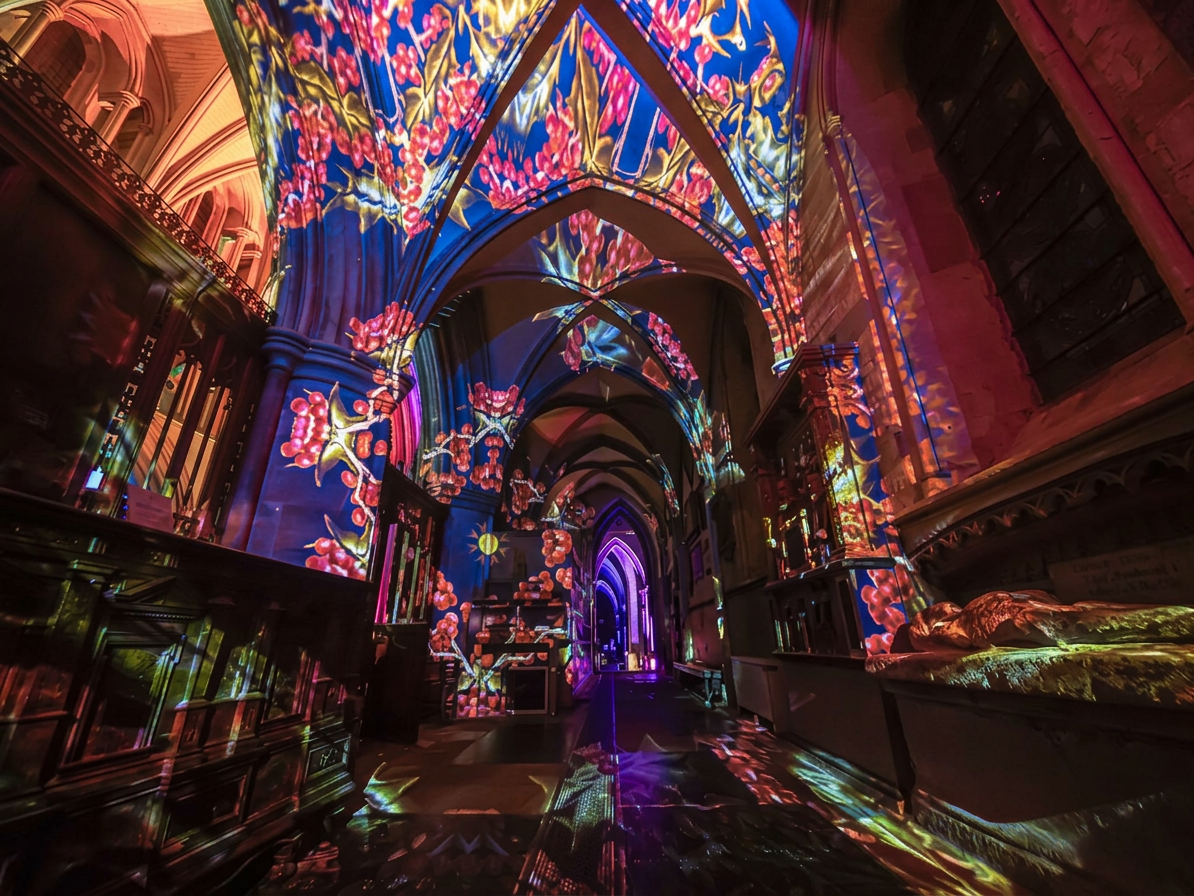
In a large cathedral, you commission a light installation that runs every night for one week to honor the loss of your spouse. The light is projected across stone walls, vaulted ceilings, stained glass—dynamic and colorful, shifting between stark geometries and intricate floral patterns. The geometries are your lost one’s logic, their structure, the way they organized the world. The florals are their softness, their beauty, the way they made things grow. Ambient music fills the space—compositions of mourning and longing, swelling and receding like breath.
The cathedral is open to the public. Anyone can enter. Strangers walk through the doors and are immediately inside your grief. They don’t know your spouse’s name. They don’t know how they died or what you lost. But they see the light move across stone, and they feel something break open.
This is the gift: your loss becomes a doorway. People come to witness beauty, and they leave having touched the edge of something they can’t name. Some cry for reasons they don’t understand. Some sit in silence for an hour. Some return every night of the week because the installation gives them permission to feel what they’ve been avoiding.
You attend every night. Sometimes you stand in the back and watch strangers experience what you made. Sometimes you sit in the front pew and let the light wash over you. The installation doesn’t bring your spouse back, but it does something else—it transforms your grief into something the world can hold with you.
By the final night, the cathedral feels like a living monument. The light has been witnessed by hundreds of people. Your spouse’s essence—geometry and florals, structure and softness—has moved through strangers’ bodies and changed them.
When the week ends, the installation is gone. But the memory of it remains in everyone who entered. You’ve learned that grief doesn’t diminish when shared—it becomes luminous. That beauty made from loss is not a betrayal of sorrow, but an honoring of it.
You’ve turned the most private devastation into the most public offering. And in doing so, you’ve let the world love your lost one as well.

