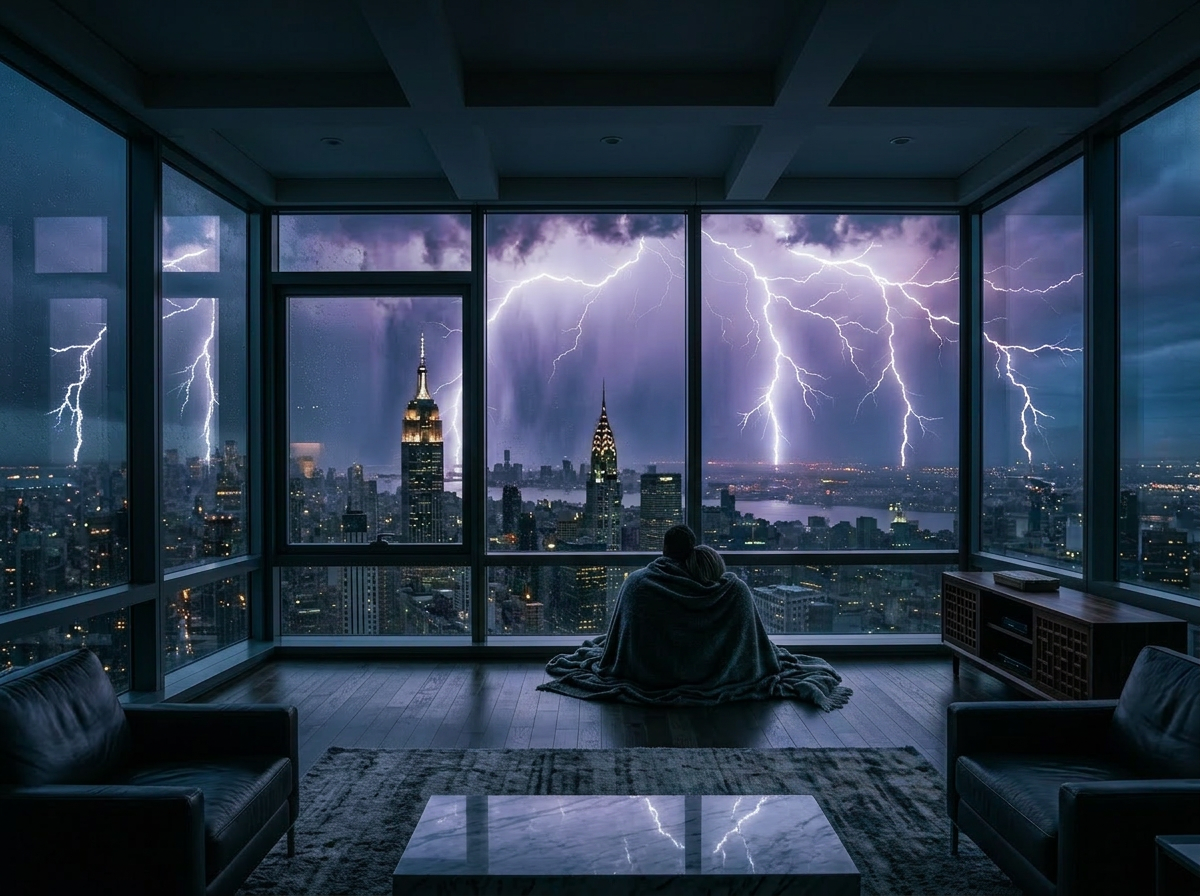
Book a high-rise hotel room when severe weather is predicted. Not just any room—a tower suite with floor-to-ceiling glass windows that give you a panoramic view of the city and the sky. A room high enough that the lightning feels close, that you can see the storm rolling in across the skyline, that the glass is all that separates you from the chaos outside.
You stay awake through the entire storm. You’re here to meet it face-to-face, present and awake together. You’ve made “lightning in a bottle” cocktails—something electric, something that burns going down. Vodka, lime, a spark of ginger. Every time lightning flashes, you drink. Every flash illuminates your faces in stark white light, and you drink to it like a toast to being alive.
The storm builds. Lightning cracks across the sky and the glass becomes a mirror—you see yourselves reflected against the chaos, your bodies doubled in the dark glass with the storm raging behind your reflections. Thunder follows, rattling the windows. You watch the city lights flicker below.
As you take in the moment, you tell each other what it feels like to witness the storm. You speak to what your partner ignites in you. You speak a confession you’ve been holding back. The storm gives you permission to speak truths you’d normally swallow. Lightning flashes. You drink. Thunder rolls. You hold tighter.
Then something shifts. You spread a soft blanket on the floor near the glass, close enough that the storm’s light will reach. One of you lies down undressed, while the other sits nearby—witness and caretaker. The storm rages beyond the glass. Lightning flashes and your partner’s body is illuminated—stark white light against darkness, every curve and line revealed for a heartbeat before the dark returns. Flash. Their skin glows. Dark. Gone. Flash again. You see them as if for the first time, as if the storm is showing you what you’ve been too distracted to notice: how beautiful they are, how mortal and present. A figure illuminated in a surge of light.
With each lightning flash that illuminates their body, you tell them what is electric about them. You watch them in the light committing every detail to memory. Not posed. Not performed. Just them, illuminated by the storm, offering themselves to be seen. Each flash becomes a frame: their body against the flash, their hand reaching for yours.
Then you begin to touch them in a way that mimics the energy of the storm. Your fingertips start at their temples, trembling slightly. You trace down their neck, across their shoulders. You’ve brought ice from the minibar, and you run a cube along their collarbone. They gasp as cold meets warm skin, their body arching slightly. You follow the ice trail with your warm hands, creating contrast—cold then heat, shock then comfort. You massage their body with a massager that vibrates with the storm’s rhythm—gentle during the quiet moments, firmer when thunder shakes the glass. The storm provides the soundtrack: rain hammering, thunder punctuating. They tremble with excitement. You make their body electric channeled from the storm through the glass.
Soon after, you help them soften, you help them sit up. You wrap them in the blanket, hold them close. Then you switch. Now you lie down on the blanket, and they become the witness.
Lightning flashes and you’re exposed—your body lit up against the dark, vulnerable and offered. They begin to speak their own electric thoughts and temptations. The moments when they felt alive and charged by your physical presence. They take you in as the storm illuminates the room in flashes. Then their hands begin—ice and warmth, vibration and stillness, firm and gentle. You surrender to being touched and being seen.
As the storm starts to pass and the rain softens to a whisper, you’re both wrapped together in the blanket near the windows. You sit together at the glass, palms pressed against the cold surface. The last bit of lightning strobes across your reflections and you see yourselves multiplied: your bodies here, your reflections in the glass, the storm beyond. Your bodies are still humming—not from the storm outside, but from the electricity you created between you. The glass is fogged with your breath. The air smells like ozone and intimacy. You’ve been witnessed by something older and wilder than yourselves, and you’ve answered its call by choosing to be fully, wildly alive together.

