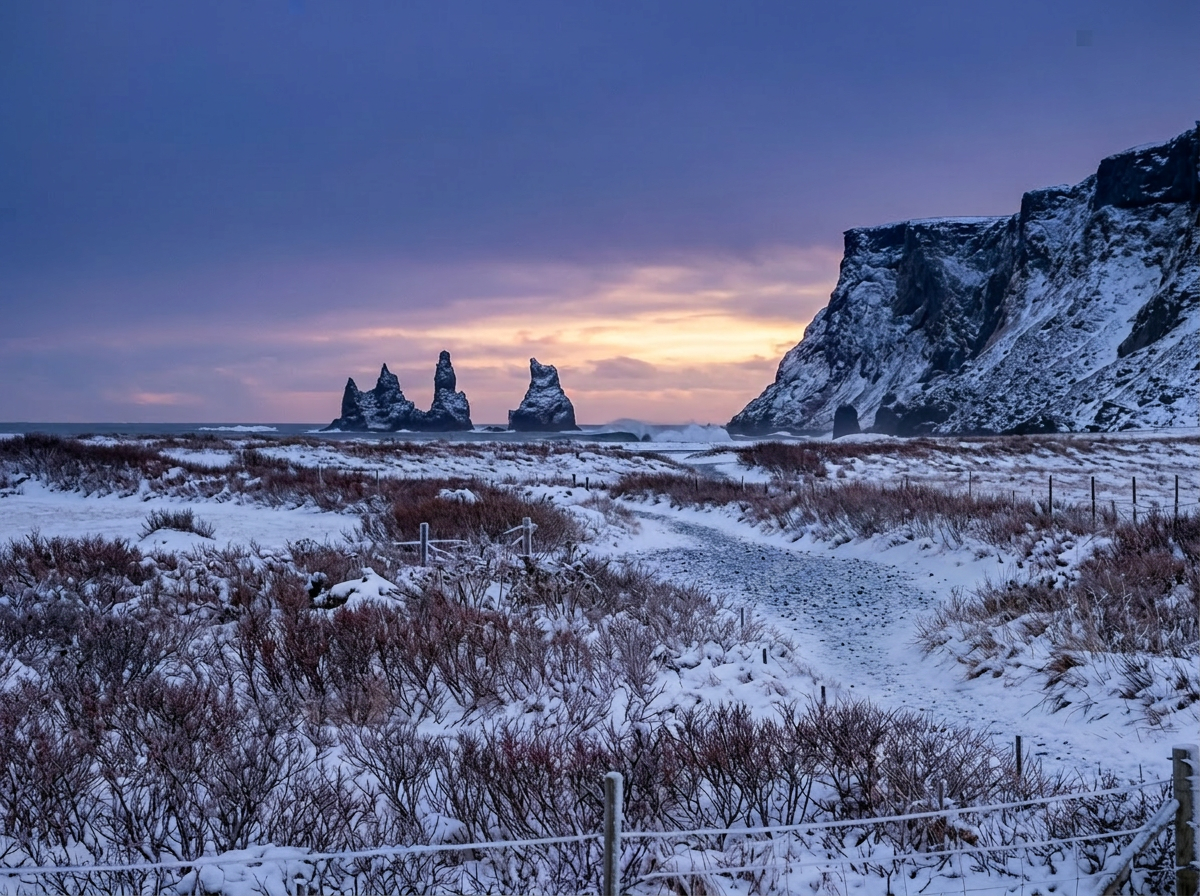
Fate works differently when daylight becomes scarce. In Vík, Iceland, during the season of extreme darkness, the sun rises for barely four hours before surrendering to night again. This experiment asks you to spend a month in that liminal space, hunting for strangers in brief windows of light, then learning who they are across long stretches of darkness.
You begin alone in a heated cottage at the edge of town. Each morning, a profile arrives in your inbox—a stranger’s name, their passions, what they’re searching for, one cryptic hint about where they might be. “She collects sea glass at dawn.” “He drinks coffee at the red house on Víkurbraut.” “They sketch birds near the black sand church.” You have four hours of pale winter light to find them in Vík’s narrow streets, its wind-battered coastline, its handful of cafés and shops. If you find them, they return with you to the cottage. If you don’t, they vanish. A new profile arrives tomorrow.
When you find someone, the real experiment begins. You spend three days together in the cottage while darkness dominates—twenty hours of night, four hours of dim light. You cook meals. You talk by firelight. You learn their stories without the distraction of a world outside. Intimacy accelerates in isolation. By the third day, you know how they laugh when they’re nervous, what silence sounds like between you, whether they’re someone you want to keep searching with.
On the fourth day, a new profile arrives—but now you hunt together. Two people searching the frozen streets, comparing notes, splitting up to cover more ground before the light dies. If you find them, the party grows to three. Three days of darkness follow. Conversations deepen. Dynamics shift. Some people become close. Others orbit at the edges. Then another hunt. Another stranger. Another chance.
The cycle continues for a month. Some profiles you find within an hour—standing exactly where the hint suggested, as if fate wanted you to meet. Others you search for desperately and never locate. You pass them on the street days later and wonder: was that them? The party grows unpredictably. By week three, six people share the cottage. By week four, maybe eight. Or maybe just three—because some hunts fail, and failure means permanent absence.
What you discover: community isn’t built through choice alone. It’s built through limitation, through the urgency of brief light and the spaciousness of long darkness. The people you find become your temporary family—not because you chose them from infinite options, but because you found each other within impossible constraints. And the ones you miss? They haunt you. You learn that missed connection is its own kind of intimacy—the ache of almost, the profile you never stopped thinking about.
By month’s end, you leave Vík with a collection of souls who found each other in the dark. Some you’ll see again. Some live only in memory. But for one month, you built a world together—hunting in light, becoming in darkness, learning that fate is just another word for showing up when the window is brief and the night is long.
 Life Arts Laboratory