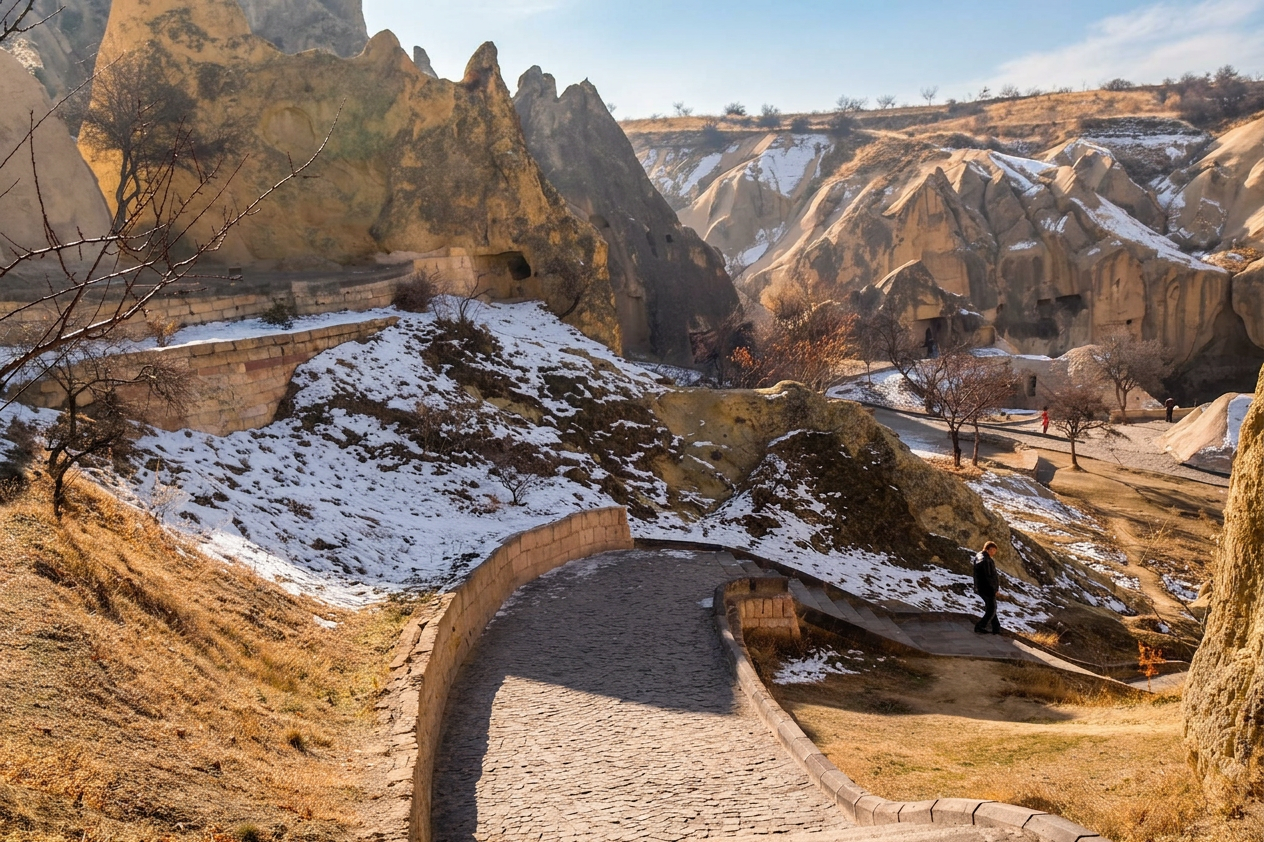
Roads remember what we forget. Every highway you’ve driven, every dirt path you’ve walked, every street corner where you stopped to catch your breath—they exist somewhere in your archive, waiting to be stitched back together. This experiment asks you to gather those fragments and let an AI reconstruct the journey of your life as one continuous, impossible drive.
Begin by collecting photographs of roads from the past twenty or thirty years of your travels. Not landmarks or destinations, but the roads themselves—the asphalt stretching toward mountains in Patagonia, the cobblestone alley in Marrakech, the coastal highway in Big Sur, the dirt track through rural Vietnam, the snow-covered pass in the Alps. Gather hundreds of them. Every territory you’ve crossed, every path that carried you from one version of yourself to another.
Feed these images into an AI trained to generate videos from images. For each photograph, the AI creates a five-minute sequence—a realistic, immersive landscape extrapolated from what the image suggests. The Patagonian road extends into windswept plains and jagged peaks. The Marrakech alley opens into a maze of terracotta walls and hanging lanterns. The Big Sur highway curves endlessly along cliffs where the ocean crashes below. The AI doesn’t just replicate—it imagines, filling in what the photograph implies but doesn’t show.
The result is a film that cuts seamlessly between locations. You’re driving through Vietnam, then suddenly the road shifts and you’re in the Alps, then Morocco, then California. The transitions are dreamlike, impossible, but the roads themselves feel real. The AI generates soundtracks for each location—wind through mountain passes, the hum of a distant call to prayer, waves crashing, gravel crunching under tires. The film is hours long, a compressed chronicle of everywhere you’ve ever been, stitched into one surreal, unbroken journey.
Watch it alone, late at night. Let the roads wash over you. You’ll recognize moments—that exact curve, that specific light. But you’ll also see roads you don’t remember taking, places the AI invented from the edges of your photographs. The film becomes a mirror of your life’s movement, proof that you were always in motion, always searching, always driving toward something just beyond the frame.
When it’s finished, the film becomes an heirloom. A record not of where you arrived, but of every path that carried you there. Your children can watch it and see the world you crossed before they existed. And you can return to it whenever you need to remember: you were here, and here, and here. The roads guided you. And now they always will.

