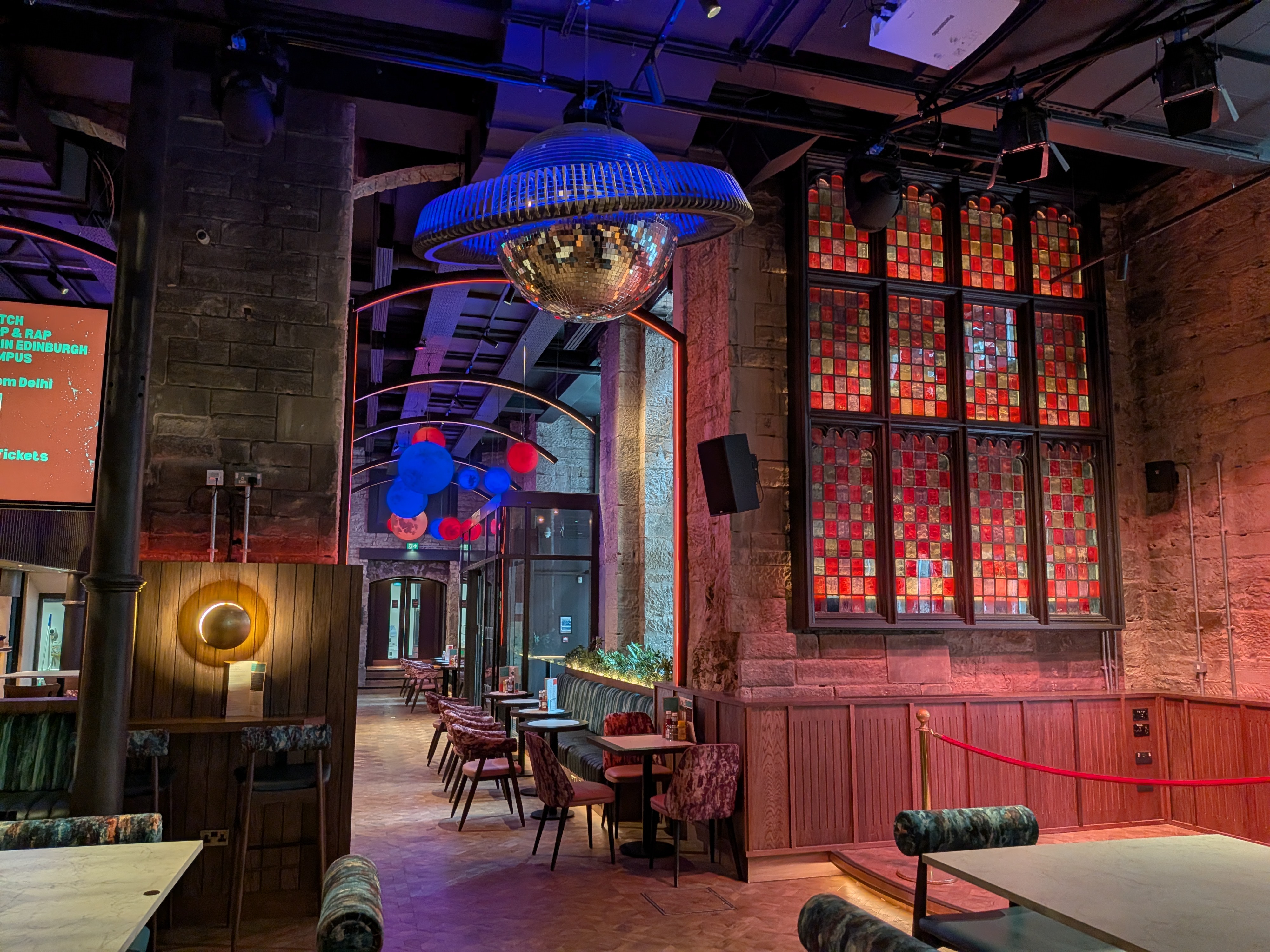
You’re going to make your city into a gallery of sound. For seven days, eight of your favorite albums will each inhabit a different space across the city. Each space is designed to make the album visible, tangible, experiential. Visitors will move between these eight worlds, spending an hour or a day immersed in the frequencies that shaped you. They’ll write their thoughts in guest books. They might discover themselves in your music. The exhibition is part art installation, part invitation to strangers: come live inside this sound with me.
Space One: What We Must by Jaga Jazzist — A penthouse rooftop, glass and steel and the city sprawling below. You’ve transformed it into a landscape of geometric precision meeting organic chaos. Modular furniture in unexpected configurations—cubes, pyramids, asymmetrical lounges. The album’s intricate jazz-prog architecture plays through speakers hidden in planters filled with ornamental grasses that move in the wind. You’ve installed prisms that catch the afternoon light, throwing rainbows across the concrete. At night, projection mapping turns the surrounding building walls into moving canvases of color and pattern. Visitors wander between zones—some dancing, some lying on their backs watching clouds, some just standing at the edge feeling the music lift them above the ordinary. The guest book is sleek, minimalist. People write about feeling like they’ve entered the future, about complexity that somehow makes sense.
Space Two: The Young Effectuals by Helio Sequence — A gallery space gutted and rewired into a lounge of light. You’ve built low platforms covered in velvet cushions, arranged in a circle around a central light sculpture that pulses and shifts with the album’s shimmering synth-pop. The walls are lined with programmable LED panels that respond to the music—waves of amber, violet, electric blue washing across the room in time with the melodies. Everything is soft edges and warm glows. A bar in the corner serves drinks named after song titles. Visitors sink into the cushions, mesmerized by the interplay of sound and light, conversations happening in hushed tones between strangers who feel like they’ve known each other for years. The guest book glows faintly in the dark. Entries describe feeling suspended in a dream, about beauty that doesn’t demand anything from you.
Space Three: Fleet Foxes by Fleet Foxes — A hiking trail in the city park, transformed into a pilgrimage through folk mythology. You’ve installed the album to play from solar-powered speakers hidden along the two-mile path, the harmonies drifting through the trees. At intervals, you’ve created installations: a circle of birch branches woven into a cathedral arch, vintage quilts hung between oaks like prayer flags, a clearing where visitors find hand-carved wooden instruments they can play. Wildflowers planted deliberately to bloom this week. The trail ends at a small meadow where you’ve set up a fire pit and Adirondack chairs. Visitors arrive breathless, sit in silence or sing along softly. The guest book is weatherproof, kept in a wooden box. People write about remembering what it feels like to be part of nature, about voices harmonizing with something ancient.
Space Four: Chairman of the Board by Count Basie — A restored dance hall, all hardwood floors and art deco fixtures. You’ve brought it back to 1959. The album plays through a vintage sound system that fills the room with warm, crackling swing. You’ve hired dance instructors to teach basics at the door—no experience required. The bar serves old fashioneds and sidecars. Visitors arrive in street clothes and within minutes they’re spinning, laughing, learning to trust a stranger’s lead. The energy is infectious—three generations on the floor at once, everyone moving to Basie’s effortless groove. Disco balls throw light across faces flushed with joy. The guest book sits on a table near the coat check. Entries are breathless, written between dances, about remembering that their bodies know how to celebrate.
Space Five: Yoshimi Battles the Pink Robots by The Flaming Lips — A university cafe, transformed into a psychedelic wonderland. You’ve covered every surface in day-glo paint, hung inflatable robots from the ceiling, set up bubble machines that fill the air with iridescent spheres. The album plays loud—joyful, weird, unafraid. You’ve replaced the regular menu with items named after lyrics: “Evil Will Prevail” espresso, “Fight Test” smoothies. Students and strangers crowd around tables covered in coloring books and crayons, drawing while they listen. A photo booth in the corner with costumes. Everything is permission to be silly, to remember that life is strange and that’s beautiful. The guest book is covered in stickers. People write about feeling like kids again, about the relief of not taking everything so seriously.
Space Six: The Lost Birds by Christopher Tin — A cathedral, borrowed for the week and filled with an unusual congregation. You’ve invited spiritual leaders from different traditions—a rabbi, an imam, a Buddhist monk, a Unitarian minister, an indigenous elder—to sit in the space during visiting hours, available for quiet conversation. The album’s choral requiem for extinct birds plays softly, filling the vaulted ceiling with aching beauty. Visitors enter, sit in pews, and sometimes approach the leaders with questions about loss, about what we owe to what we’ve destroyed, about hope. The conversations are gentle, profound. Candles flicker. The guest book is placed near the altar. Entries are prayers, apologies to species we’ll never see again, commitments to do better.
Space Seven: Blues Caravan by Buddy Rich — A restored 1960s jazz club in the basement of a downtown building, intimate and velvet-dark. You’ve recreated it exactly as it might have been—low ceilings, small round tables with white tablecloths, a bar of polished mahogany, a modest stage set up close enough that visitors feel the musicians’ breath. Buddy Rich’s drumming plays loud and alive through vintage tube amplifiers that crackle and hum. The album’s energy is undeniable: percussive, wild, restless. You’ve set up a small bar serving strong cocktails in tin cups. Visitors arrive expecting something polished and leave electrified—the drums are impossible to ignore, they demand movement. Some tap their feet. Some dance. Some stand transfixed by the sheer technical virtuosity of Rich’s playing. The space feels like a traveling show, temporary, alive with the urgency of musicians who’ve been on the road too long and play like they might never play again.
Space Eight: Ágætis byrjun by Sigur Rós — An abandoned swimming pool, drained and converted into an amphitheater of sound. You’ve lined the bottom with cushions and blankets. Visitors climb down the ladder and lie on their backs, staring up at the sky while the album’s glacial post-rock washes over them from speakers positioned around the pool’s edge. The Icelandic lyrics remain untranslated—you want people to feel the music without understanding it, to surrender to pure emotion. At night, you project slow-moving images of northern lights and volcanic landscapes on the pool walls. Visitors stay for entire album cycles, some crying, some holding hands with strangers. The guest book is at the top of the ladder. Entries are in multiple languages, about feeling homesick for places they’ve never been.
Seven days. Eight spaces. Visitors from across the city. You spend the week moving between locations, watching people experience your private musical journey made public. You read the guest books each night—strangers writing about their own memories attached to these albums, or discovering them for the first time, or just grateful that someone built a room where they could feel something fully.
You learn that your city has been waiting for permission to slow down and listen. That music is a language more universal than you realized. That the albums you carried alone have been carried by countless others, each person building their own invisible rooms around the same frequencies. By the final day, you understand: you didn’t just create an exhibition. You created proof that the soundtrack of your life has always been a shared frequency, and that beauty multiplies when you stop keeping it to yourself.
 Life Arts Laboratory