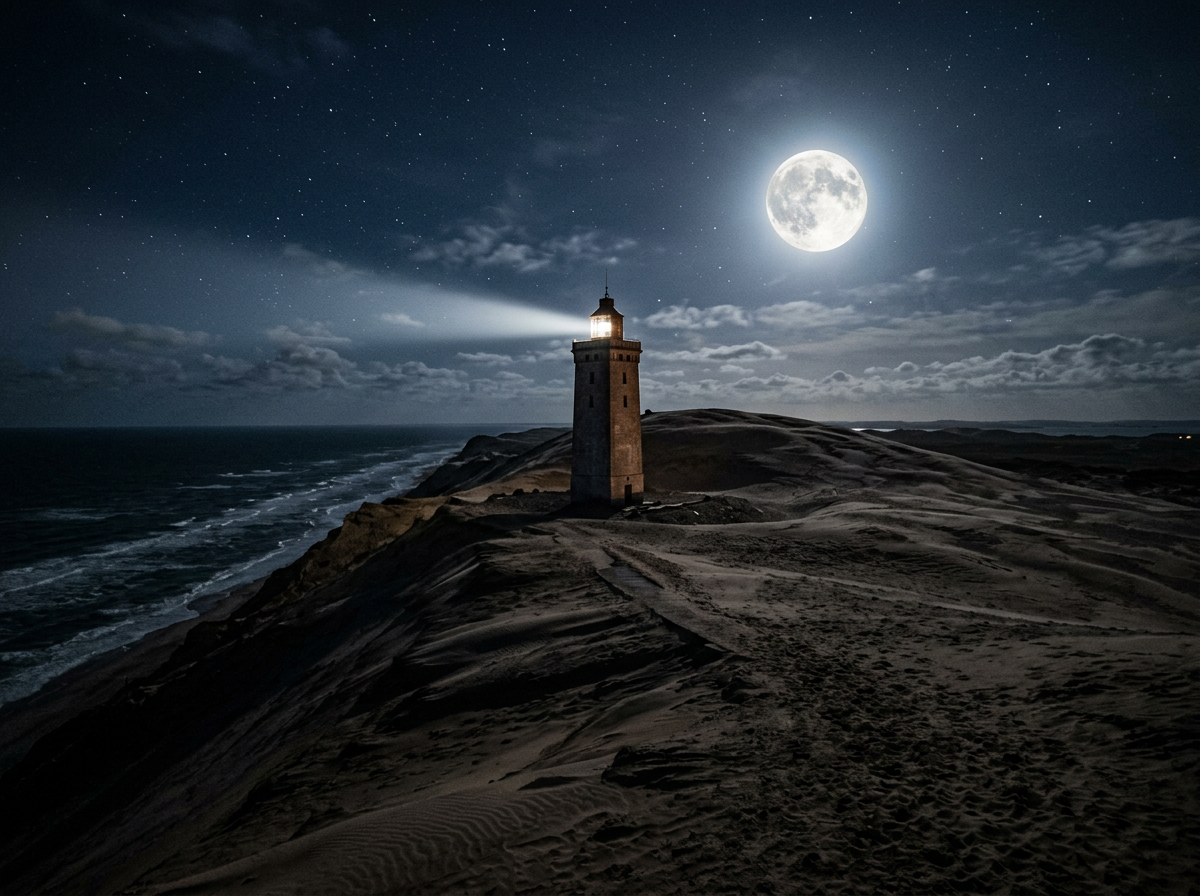
Most people send messages into the world hoping for replies. You send yours into the North Sea knowing you might never hear back.
Once a month, when the moon swells full over the coast, you drive to a beautiful lighthouse on the North Sea. The structure stands defiant against the wind and erosion, a sentinel perched on a cliff that loses sand to the sea each year. But standing at the cliff’s edge, you understand why this place calls to you. Where the light guides others, you release your own light into the world.
You arrive an hour before moonrise and walk the land in darkness, feeling the cold North Sea wind against your face. Under the full moon, the white tower glows like bone against the black sky. You stand overlooking the water where sand meets air meets water, and you watch the waves arrive from somewhere you’ll never see.
In your backpack, you carry a single biodegradable bottle made of compressed seaweed and natural polymers. Inside it, you’ve placed two handwritten pages. The first describes a moment of hope you experienced since the last full moon—something that reminded you the world still holds beauty, that people still choose kindness, that meaning still emerges from chaos. It might be witnessing a stranger help an elderly woman across a busy street. It might be your daughter laughing so hard she couldn’t breathe. It might be the way morning light broke through storm clouds after three days of rain. Whatever it was, it mattered. It gave you hope. And now you’re giving it away.
The second page contains a poetic life experiment or piece of wisdom you want to share with the world. Something you’ve learned by living: a practice that changed you, a realization that reoriented your life, a question worth asking. Before sealing the bottle, you add a small amount of phosphorescent glow in the dark paint to the inside—completely nontoxic, eco-safe, but enough to help the bottle glow soft-blue green as it travels through the night. You also include a small QR code etched into the bottle’s label. If someone finds it, they can scan the code to access your complete digital archive—every bottle you’ve released, every story, every hope documented across your lifetime. Your existence becomes discoverable. Your journey becomes theirs to witness.
You stand at the cliff’s edge. The moon is fully risen now, laying a silver path across the black water. You hold the bottle up to the moonlight, shake it gently, and watch it glow in your hands like captured starlight. Then you pull your arm back and throw it as far as you can into the North Sea.
The bottle arcs through the darkness, glowing as it tumbles, and hits the water. For a moment, you see it—a small blue light bobbing in the waves, moving with the current. Then the sea takes it. The North Atlantic Drift will carry it somewhere. Maybe to Norway. Maybe to Iceland. Maybe to Scotland or the Faroe Islands. Maybe it will circle back to where you threw it months from now, unrecognizable, worn smooth by salt and time. You don’t know who will find it. You don’t know if anyone will. But that’s not why you’re here.
You return every full moon for years. Twelve bottles a year. After five years, sixty messages of hope are circulating in the North Sea’s currents. After ten years, one hundred twenty. Each one contains evidence that you existed, that you noticed beauty, that you learned something worth sharing. Each one is a small act of faith that the world is worth speaking to, even when it doesn’t speak back.

