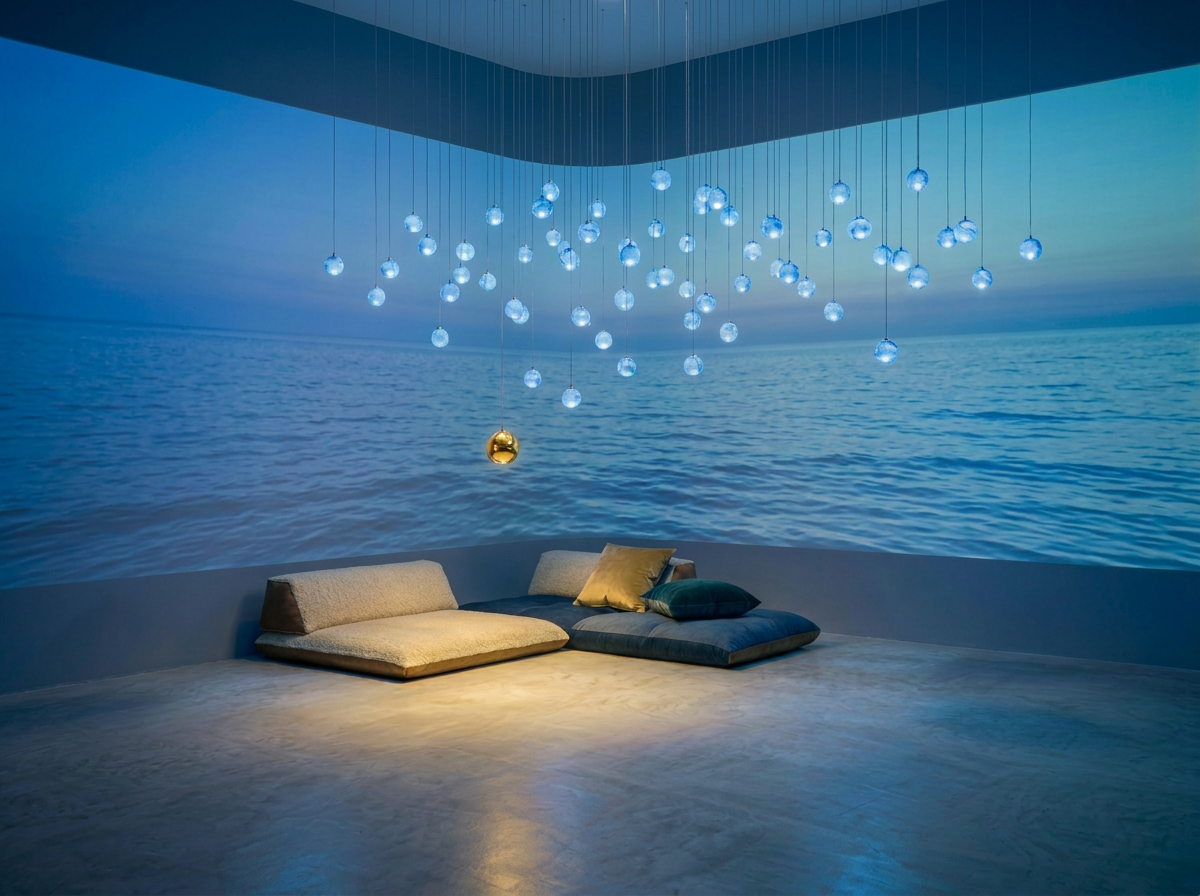
Imagine walking into a room where your ceiling holds your life—glass orbs catching light, casting shadows that move across your walls. Each sphere suspends a single peak moment: the valley you crossed on foot, the moment you loved deeper than ever before, the sunset at the edge of the world. They hang like stars that never fade, a constellation you can stand beneath and access whenever you need to remember what you’re capable of feeling.
Choose a room with high ceilings—a living room, a studio, a meditation space—somewhere you’ll inhabit daily. Install a grid system of small ceiling hooks or a track-mounted suspension system that allows flexibility. You’ll be adding to this installation for decades, so the infrastructure needs to accommodate growth.
Purchase clear glass pieces—smooth, spherical, about three to four inches in diameter. No variations in color or texture. Each orb’s significance comes from its story, not its appearance. When you look up at your ceiling, you see a field of spheres, each one holding equal weight, each one a portal to a different moment of your life.
When you experience a peak moment—a moment of transcendence, overwhelming joy, or profound connection—you dedicate an orb to it while the memory is still vivid. First, you document the moment in your digital archive: a custom database or app where you record the date, location, what happened, who was there, what you felt, why it mattered. You record an audio narration—three to five minutes where you tell the story aloud as if speaking to your future self. Describe not just what happened, but what it meant, why this moment deserves to be suspended above you for the rest of your life.
Next comes the physical installation. Using nearly-invisible monofilament fishing line (20-30 lb test), suspend the new orb from your ceiling at a height and position that feels right. Some orbs hang low enough to touch. Others float near the ceiling, distant and unreachable. The varying heights create depth, movement, a three-dimensional map of your life’s peaks. No two orbs hang at exactly the same height.
Connect your digital archive to a smart speaker system and, if possible, a projector mounted discreetly in the room. When you access a specific moment in your archive—via voice command, phone app, or computer interface—the system triggers an automated response. Your recorded memory from that moment plays on the wall surrounding you. After a couple cycles your narration of the event plays through the speakers, filling the room with your own voice telling the story. The system illuminates the corresponding orb in gold and projects images from that moment onto nearby walls.
You stand beneath your constellation and listen to yourself describe the day you summited that peak in the Dolomites, the early morning your child was born, the moment you sailed deep into the Mediterranean Sea. The orbs glow faintly in projected light. Your past self speaks to your present self. The room becomes a theater of memory.
Over months and years, the installation grows denser. What began as three or four orbs becomes twenty, then fifty, then a hundred. The ceiling transforms into something otherworldly—a field of suspended glass that catches light and scatters it across your walls in beautiful shades.
You learn to read the constellation. You recognize clusters—orbs from the same year, the same relationship, the same phase of life. The installation becomes a visual autobiography, honest and accumulating. Some mornings you wake and simply lie there, looking up at the evidence of your life’s beauty. Other times you access the archive randomly, letting the system choose a moment for you, reintroducing you to a peak you’d half-forgotten. The orbs become companions—silent witnesses to who you’ve been, reminders of what you’re capable of feeling.
By the time you’re old, your ceiling is crowded with glass. A lifetime of peaks suspended above you. And when you die, the installation remains—a physical archive of your joy, a constellation that your loved ones can stand beneath and access, hearing your voice tell the stories that mattered to you most.

